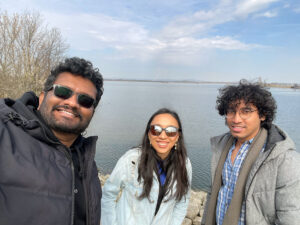
In March, three of us from CEMUS, Ankit Jajoo, Isabela Villamizar Ariza and Udesh Fernando, course coordinators at CEMUS, took part in the ENLIGHT Thematic Network (ETN) “B-MOVE: Beyond Migration: Organisms, Matter, Voices, Ecologies” workshop in Bratislava Slovakia, hosted in collaboration with the ENLIGHT partner university, Comenius University Bratislava.
Part of the wider ENLIGHT network, B-MOVE brings together students, researchers, and educators to explore migration and mobility beyond human-centred perspectives, connecting ecological processes with cultural and creative practices.
ENLIGHT is a European university network to promote equality, increased quality of life, sustainability, and global engagement through higher education.
Funded by the European Union. Views and opinions expressed are however those of the author(s) only and do not necessarily reflect those of the European Union or the European Education and Culture Executive Agency. Neither the European Union nor the granting authority can be held responsible for them.
Learning with the river
 The workshop unfolded as an immersive outdoor learning experience where participants directly engaged with the Danube River, particularly at the irrigation project of the Danube River on the outskirts of Bratislava and then in the inland Danubian floodplains near Bodíky.
First we were guided at different parts of the irrigation project where we understood the larger context of the Danube water management project and its multiple uses. There we also understood the ecological impacts of this large scale project and how it continues to contest with nature.
We were fortunate to be accompanied by Mirko Bohuš and all the experts rallying on the project, who shared their deep knowledge of the Danube ecosystem with great passion. Mirko, drawing on his expertise as an ornithologist and a Danube conservationist, introduced us to bird species, their migration patterns and behaviours, and how they adapt and thrive within expanding floodplain forests.
We also explored the differences between native forest ecosystems and monocultures, opening up discussions on biodiversity, land use, power, and ecological resilience.
Movement, ecology, and immersion
Rafting through the branching waterways of the Danube, we experienced mobility in a tangible way. Navigating the river’s side channels required attention, coordination, and trust, making the idea of “movement” something lived rather than abstract. Through the experience of movement this larger immersion in the Danube made us realise and connect our theoretical know-how of how development, energy requirements, water needs, power and adaptation come into play in diverse aspects.
The guided immersions created space to reflect on our own relationship with nature, not as something separate, but as something we are constantly moving within and shaped by. Learning from each other, sharing our lived experinces and connecting that knowledge to the goals of this project was also a great experience that enabled co-learning ambitions.
Connecting policy, landscape, and imagination
 Alongside field-based learning, the workshop introduced broader European frameworks shaping sustainability work today. Through in-house lectures and discussions, we engaged with the European Green Belt Initiative, the New European Bauhaus Initiative and Nature Based Solutions, exploring how ecological restoration, cultural heritage, and design intersect across the region.These perspectives highlighted how environmental and social transformations are deeply interconnected, linking local ecosystems like the Danube floodplains to wider European visions for sustainable and regenerative futures.
Art as a way of knowing
The workshop concluded with a visit to the Danubiana Art Museum, where we reflected on how sustainability and ecology can be expressed through artistic practice. Engaging with the exhibitions opened up alternative ways of representing environmental change, where storytelling, visual art, and creative expression become tools for understanding and communicating complex ecological realities.
Carrying the experience forward
As part of the ongoing B-MOVE collaboration between Uppsala University, University of Galway, Comenius University Bratislava, and Ghent University, this workshop marked one step in a longer journey of interdisciplinary learning.
For us, it was also an experience of thinking with water bodies, landscapes, and more-than-human life perspectives. Migration in that sense is not merely about crossing borders, but about the constant movement of life, matter, and meaning through the diverse spaces and realities we inhabit.
Read more about the first meeting and launch in February 2026: https://www.cemus.uu.se/enlight-b-move-1/