
Program for ClimateExistence released! – with parallel sessions


We have an exciting program lined up for all of you registered for ClimateExistence 2026! Updates on parallel session will be announced next week.

Registration: is now closed, send a sms or call +46 073-065 02 28 if there’s any issues with your registration.

If you have any questions please contact conference coordinator Daniel Mossberg, sms or call +46 073-065 02 28.


Exhibitions and rooms open throughout the conference


Monday November 16

The program will be updated up until November 16. Click on rooms to get directions and maps.

Time
Program
08.45-09.15 Registration

[22 Mingle space outside of Humanities Theatre]
09.15-09.20 Daniel Mossberg Welcome to ClimateExistence 2026!

[22-008 Humanities Theatre, English Park Campus]
09.20-10.30 Kevin Anderson Keynote 1: A velvet or violent climate revolution: which will we chose? followed by panel

Kevin Anderson, Professor of Energy and Climate Change, University of Manchester, will deliver a keynote during day 1, November 16, bringing us the latest on the state of the climate, carbon budgets, climate justice, and rapid transitions. https://www.cemus.uu.se/ce-2026-ka/ Followed by panel.

[22-008 Humanities Theatre, English Park Campus]
10.30-12.00 Part 1: The 9th flower – a walking performance-ritual guided by Ida Lod and Julia Adzuki, artists and somatic facilitators

Join us for an immersive experience through the Botanical Garden of Uppsala. Together we will explore deep listening, emergent imagery and somatic reflection through sounds, song and poetry.

Inspired by Carl von Linnés 8 Herbationes Upsalienses (botanical excursions) and the artist Bernt Nyberg’s illustration, we will explore relationships to uncertainty, grief, resilience, everyday life, death and new beginnings through all the senses.

Pick up coffee, tea on the way out.

[Starting outside of entrance 22-008 Humanities Theatre, English Park Campus]
12.00-13.00 Lunch

[To be announced]
13.00-14.45 Parallel sessions 1
Session 1

Paper presentations:

Ida-Maja Lindström
Living through climate change: everyday practices of care, survival, and ecological responsibility in alternative lifestyle movements

Sofia Oreland
“We aimed to demonstrate that faith and religion serve as resources in society.” Interreligious climate initiatives in Sweden.

Description
This study examines how religious actors in Sweden collaborate across faith traditions to address the climate crisis, a field that has received limited scholarly attention. Drawing on websites, social media, newspapers, emails, and interviews, it maps different initiatives and their approaches to climate issues. The findings reveal a wide range of activities, including advocacy, education, dialogue, local environmental projects, and international support. Grounded in climate science, these initiatives highlight both the practical and spiritual resources of religion. Religious traditions are presented as important contributors to sustainable transformation by fostering hope, justice, care for creation, and a critical stance toward consumerism.

Jasmine Aavaranta
Enchanting the Baltic Sea: Mermaiding as a Form of Ocean Advocacy

[22-1009 Seminar room, English Park Campus]
Session 2

Miguel Vian, Emilia Sjöqvist, Adam Beswick, Veronika Sveidqvist, Raquel Frescia and Markus Ebel
Creative writing for hope and resilience in the Anthropocene

Description
The workshop entails a collaborative simultaneous writing session. We will bring a “resilience journal”, a handmade book made of scraps and pieces that the group will collaboratively fill up with their writing. After a short presentation of the group and introduction of several themes, such as grief and resilience, we will propose several writing prompts inspired by the environmental humanities. Participants and organizers will write their speculative contributions and, if they so desire, add them to our resilience journal. At the end of the session, we will discuss our experiences and engagement with the writing prompts and bring together the journal as a tangible testimony of our work.
[22-1017 Seminar room, English Park Campus]
Session 3

Isabela Villamizar Ariza and Vera Brandes
World Café: Imaging a future for CEMUS

Description
At a time when the future of CEMUS is uncertain, this World Café invites you to come together with others and collectively imagine what the future of CEMUS could look like. Through open conversations, shared reflections, and creative thinking, we will explore what makes CEMUS meaningful, what we wish to preserve, and what new possibilities might emerge. Rather than focusing primarily on what is at risk, this workshop creates space to envision the role CEMUS could play in the future.
[22-0031 Seminar room, English Park Campus]
Session 4

Kevin Anderson
A Fireside Carbon Chat: A critical conversation based on your questions

[2-0024 Seminar room, English Park Campus]
14.45-15.15 Fika break with coffee, tea and fruit

[22 Second floor above mingle space outside of Humanities Theatre]
15.15-17.00 Parallel sessions 4
Session 1

Belinda Retourné
What is the purpose of your visit? “The Baltic Sea Visa Office” — Exploring belonging through institutional fiction

Description
Those of us who live around the Baltic Sea have never had to explain why we want to be there. We swim in it, travel on it and eat from it. Access has always been a given, and what is a given isn’t always valued properly. Decades of research and alarming reports on the state of the sea have not changed that. Information, it seems, is not enough.

So what if the sea closed its borders? What if the Baltic Sea declared itself a sovereign state and required an entry visa from anyone wishing to spend time in or by it? What reason would you give? And who decides whether it is good enough?
This is the premise of The Baltic Sea Visa Office. At a newly opened and hopelessly understaffed consulate, participants apply for entry. They fill in forms, state their reasons for wanting access, and navigate the procedures of a bureaucracy still finding its feet.

This session is a playtest of a condensed version. You go through the application process as a real applicant, then step out of the fiction to reflect on what it stirred in you, and on what worked and what didn’t. Your experience will shape the final production.

The underlying question: What becomes visible when something we have always taken for granted suddenly has to be justified?

No prior experience needed. Bring your reasons.

[22-0031 Seminar room, English Park Campus]
Session 2

Elin Boyer and Fatima Osman Abdalla
Deep Listening with the More-than-human World

Description
Join us for an exploration of the profound interconnection between human and more-than-human communities. This session will employ experiential, playful learning and embodied practices that invite participants to connect with themselves and the world around and within them. We welcome you to join us around the campfire, where we will play and also invite some silence.

Kincentric Justice is an initiative that examines the intrinsic link between our ability to effectively engage in societal issues and our relationship with the more-than-human world. We recognize that feeling disconnected from the more-than-human world is both a cause and consequence of the polycrises we face today. By cultivating a connection to our inner experiences and the more-than-human community, we can build resilience, gain inspiration, and draw insights from our more-than-human kin. These insights can guide us in developing systems and social justice efforts that align more closely with the natural cycles and processes of life, fostering what we call Kincentric Justice.

[Outside in the English Park or inside if the weather is bad 22-1009 Seminar room, English Park Campus]
Session 3

André Dutra
Teaching in the cracks: layered dialogue for staying with the trouble

Description
What happens to a conversation about the climate crisis when nobody in the room is there to or can deliver the answer? Most of us know the familiar endings: the expert solution that leaves little room for doubt, or the private despair we carry home alone. This workshop opens a different kind of space, one where urgency and grief, uncertainty and responsibility can be held together, and where listening matters as much as speaking.
The format grows out of years of dialogical, student-led teaching at CEMUS/Uppsala University and academic research, where classrooms were built around circles rather than podiums and where some of the most important insights came from voices that rarely get heard. Here it is offered as something to experience rather than a lecture about pedagogy.

Come curious. Students, teachers, artists, activists, academics, faith practitioners, and anyone wondering how to stay with the trouble are welcome. No preparation or expertise is needed, only a willingness to listen and to be surprised by what a group can discover together.

[22-1017 Seminar room, English Park Campus]
Session 4

Julie Robiolle and Vega Osman Bisschop
Imaginary of Water Conflict workshop

Description
Projections regarding precipitation indicate an aggravation of water distribution polarization for the coming years and decade. Increasing research demonstrates that this correlates with increasing water conflict, with direct consequences for the stability of democracies worldwide. But water, its imaginary and the conceptual tension it engenders, has also provided tools, strategies and powerful narratives to communities all over the world to imagine different futures. Those build upon idea of fluidity, but also soft strength to conjure images of a future where properties and violent hierarchies are replaced by new systems built on respect of our ecosystem and citizens’ autonomy.

This workshop invites you to develop on those more hopeful images, building upon the Sainte Soline and Hong Kong protests, and tentatively answer: How could water conflict act as collective triggers to imagine different futures?

[2-0076 Seminar room, English Park Campus]
Session 5

Ankit Jajoo and Ankur Jajoo
Live podcast interview on CEMUS

[2-0024 Seminar room, English Park Campus]
17.00- Allt ljus på Uppsala, light festival with art installations in Uppsala https://www.alltljuspauppsala.se/

[Uppsala]
18.30- 18.30- Conference reception, dinner at CEMUS, with open mic and thematic rooms.

[CEMUS Library, Geocentrum, Villavägen 16]


Tuesday November 17

The program will be updated up until November 16. Click on rooms to get directions and maps.

Time
Program
09.00-10.00 Finlay Malcolm Christian Climate Advocacy and Activism in the UK: Emotions, Ethics and Theological Creativity

Finlay Malcolm, Research Officer, University of Warwick and Research Fellow, University of Manchester, will give a talk on “Christian Climate Advocacy and Activism in the UK: Emotions, Ethics and Theological Creativity”. https://www.cemus.uu.se/ce-2026-fm/

Description
This talk draws together the findings from two major research projects exploring the theologies, motivations and actions of UK-based Christian climate activists and advocates. The talk will highlight the overarching environmental emotions, moral attitudes and theological stances of these activists and advocates, and will then show how these findings have been developed into training materials across national churches in the UK to inspire environmental concern and action amongst the Christian community.

[22-008 Humanities Theatre, English Park Campus]
10.00-10.15 Fast-fika, coffee and tea on the way to parallel sessions

[22 Mingle space outside of Humanities Theatre]
10.15-12.00 Parallel sessions 3
Session 1

Paper presentation and music:

Petri Lahtinen
Presocratic natural philosophy psykhe as a universal principle of interconnectedness

Description
In the early Presocratic natural philosophy psykhe functioned as a universal principle of interconnectedness, creating a complex network of relations among all living entities. It can be compared with the worldviews of many other pre-industrial and pre-humanist cultures, which can be characterised as animistic perspectivism, according to which every being is, in principle, an ensouled or spiritual agent. Explored through the theoretical framework of posthumanist paradigm, psykhe can be viewed as key element in the sifting of the Western worldviews in accordance with the sustainability transition. Psykhe constitutes an understanding of the biosphere as all-encompassing ontological and spiritual co-existence which necessitates deep ecological and sustainable modes of living.

A fundamental part of this transition is rethinking the human perspective on energy. As a multidisciplinary session, there will be an acoustic performance of an original composition demonstrating the energetic dynamic and relation between a singing human musician and a hand-made acoustic Cretan laouto. In accordance with the academic topic, the performance invites the listeners to pay attention not only to the musical performance alone but also to the experience of an acoustic sound in time, in an acoustic space, and in relation to other listeners.

[22-1009 Seminar room, English Park Campus]
Session 2

Åsa Callmer
and Sachiko Ishihara
Staying with the pain: Writing and sharing as comfort
Description
It is a hard world to be living in. While much sustainability discussions have focused on finding positive opportunities in these challenging times, very little space has been given to staying with and working through painful emotions that we encounter in sustainability work. In many Western cultures, environmental losses and death of non-human beings due to environmental destruction are neither socially validated nor publicly mourned. In this context, mourning publicly with others becomes a transformative political act, making those who died matter. Meanwhile, especially during times of distress, studies show the importance of positive emotions in buffering negative impacts of distress.

Through various writing exercises, we invite participants to explore and express these ecological emotions during this workshop. Following several prompts, participants can try putting words to a wide range of emotions such as grief, anxiety, sadness, fear, wonder, and awe. The workshop will finish with inviting participants to read and share what they wrote during the workshop. Culminating in this common reading, we situate this experimental workshop as a form of communal ritual of comfort that breaks the silence of painful emotions that many experience alone, and as a start to develop arenas for collective support and constructive engagement.

[22-0031 Seminar room, English Park Campus]
Session 3

Lakin Anderson and Oscar Hartman Davies
Museums as Archives of the Anthropocene: Counter-mapping the Swedish Natural History museum

Description
The Anthropocene unsettles the modernist separation of nature and society and calls for rethinking conventional borders between natural and human history. Empirical evidence that humans now predominantly determine Earth history requires us to connect ecological and Earth system processes with human historical records, including the key ideas, politics, economic systems, sciences and technologies that have come to shape these processes. As authoritative institutions seen to speak for the natural world, natural history museums are key sites in which understandings of nature are constructed and performed. Yet—notwithstanding notable exceptions—their methods of storytelling and exhibiting have been slow to adapt to our new Anthropocene realities. If we treated the collections of these institutions as archives of the Anthropocene as much as of Nature, what new stories could be told through and with them?

This session describes a counter-mapping project in which we engaged collaboratively with the Swedish Museum of Natural History to identify objects in their permanent exhibitions to re-present as an archive of the Anthropocene, expressing stories of extraction, extinction, ecological simplification, scientific and technological change as well as emerging forms of environmental governance. We approach counter-mapping as a process challenging dominant ways in which human-nature relations are ordered and represented, here in museum spaces. The talk outlines our collaborative process, challenges and tensions which emerged therein, and presents an interactive online map where users can navigate a trail through the museum, interacting with curated objects in the museum’s permanent exhibitions. This map functions as a visual, public record of our project and a methodological invitation to researchers and practitioners to engage in counter-mapping processes within other museum spaces.

[22-1017 Seminar room, English Park Campus]
Session 4

Luli Macchi and Janina Stachnik
Inner Foundations for a Collapsing World: From Reaction to Response – The Inner Skill of Staying Present

Description
The climate emergency is reshaping the world we are all stepping into: tipping points, dwindling carbon budgets, ecological loss and a future of lasting instability. Meeting it asks for two foundations in balance: the knowledge to understand and address the crisis, and the inner capacity to stay with the trouble over time, without burning out or turning away.

Beneath the question of how we respond lies another: what if part of the root is also inside us? The inherited patterns that shape how we live and decide also shape how we impact the world, alongside the systems we live in.

This session explores consciousness as the capacity to see those patterns: to observe how we think, feel and decide, and to respond with clarity rather than react. Through a short talk, a guided practice and conversation in pairs, participants will reflect on the inner state from which they engage with the climate crisis, and leave with a simple practice to return to when the news feels unbearable.

The session also introduces Journey to Greatness, a year-long consciousness program for university students.

Open to everyone. No prior experience needed.

[2-0024 Seminar room, English Park Campus]
Session 5

Vitalija Povilaitytė-Petri
Writing(with)Plants: multispecies care as art practice

Description
Join us for a creative workshop, Writing(with)Plants, which combines performance, storytelling, sharing memories, knowledge, collective reflections, and experimental creation to explore vegetal modes of nonhuman beings. The workshop invites participants to rethink entrenched human–nature binaries not through imaginaries of retribution, but by cultivating practices of interspecies solidarity, attention, and care.
The workshop offers engaging directly with the invited “guest plant” that serves as focal point and interlocutor. Drawing on ecocriticism, critical plant studies, and posthumanist theories of multispecies justice, care ethics and aesthetics (cfr Puig de la Bellacasa, Haraway, Mol, Bateson, Tsing, Marder, Thompson, Akomolafe, Hine, Manning), the session foregrounds the participation of plants as more than symbolic figures. Instead, plants are encountered as co-creators who embody subtle yet profound forms of growing: persistence, adaptation, rootedness, toxicity, and slowness.

The structure blends experiential and reflective elements. It begins with a storytelling circle, where participants share experiences and reflections emerging from meeting the guest plant. A guided 20–30 minute practice follows, during which participants are invited to “shapeshift” into the guest plant, accompanied by prompts around rooting, home (oikos), and care. From this embodied perspective, they produce creative artworks—poems, short stories, drawings, photos, collages, herbariums or other expressive formats—that attempt to write not about but with plants.
The session closes with a second sharing circle, offering space for participants to voice their musings, read their texts, share artworks or otherwise articulate what emerged. In this way, Writing(with)Plants unfolds both as an aesthetic intervention and as an ecological methodology, bringing together artistic performative mutual care practices, embodied engagement, and scholarly inquiry.

By situating writing as a multispecies practice, the workshop fosters forms of hospitality, conviviality, care and resistance that move beyond the logics of domination and control. It contributes to ongoing conversations in the environmental humanities, social, nature sciences and arts by asking how we might write—and care—otherwise, in collaboration and solidarity with the vegetal world.

Plant-rich room

12.00-13.00 Lunch

[To be announced]
13.00-14.45 Parallel sessions 4
Session 1

Belinda Retourné
Should I stay or should I go?
“Elysium” — Exploring climate collapse through immersive theater

Description
Anyone who works with climate and environmental issues spends a lot of time around people saying: “That won’t work.” Sustainable decisions are blocked by politics, economics, norms, regulations, you name it. And they’re right: powerful forces are uninterested in change, or actively working against it.
So what if we simply gave up on this planet? What if we built a whole new world, free from the systems and structures we have invented? How would we organize our societies and live our lives? And what would you be willing to pay?

Elysium is a world created around that idea. In this immersive theater experience, Hades, god of the underworld, runs a beauty clinic offering escape from a collapsing Earth to a digital paradise. Originally produced in Stockholm in 2025 with support from Kulturbryggan, the piece surfaces hidden tensions in how we relate to environmental decline, self-care and collective futures. It does this not through arguments or data, but by placing participants inside a shared sensory situation where the line between watching and taking part dissolves.

This session combines an introduction to Elysium and its artistic methods with a selection of participatory exercises from the production. Drawing on immersive theater, the exercises invite you to explore your own emotional and existential responses to ecological instability, including conflicting desires and strange hope, as a co-creator rather than a spectator.

The underlying question: What does the fantasy of leaving reveal about what we are not ready to let go of?

No prior experience needed. Come ready to take part.

[22-0031 Seminar room, English Park Campus]
Session 2

Anna Mössler and Anna-Josephin Eckmann
Reflecting on our Food System: A Workshop by Plant-Based Campus

Description
How are we all part of the food system, and what does that mean in times of climate crisis? In this workshop, Plant-Based Campus, a student-led initiative promoting plant-based food at universities, invites you to explore the food system through a reflective format. After a short introduction to who we are and what we do, we will talk about food systems and move through stations that invite reflection on the patterns and assumptions shaping how we eat. We close by sharing our insights and views. No prior knowledge needed, just curiosity and openness. Welcome!
[2-0024 Seminar room, English Park Campus]
Session 3

Åsa Callmer
Writing our way towards meaning

Description
When we immerse ourselves in questions about how to exist and make sense of the world in the shadow of tipping points, ecological loss, and violence against humans and nature, a wide range of emotions and thoughts arise. In this workshop, we put words to feelings and thoughts that have emerged during the conference. Welcome to navigate the uncertainty by writing together, in search for meaning and active hope.
[2-0076 Seminar room, English Park Campus]
Session 4

Isak Stoddard and Lars Noväng
Do we need to redeem or rather destitute the university?

Description
Our collaboration started in the lead up to ClimateExistence 2023 with an invitation to conference participants to bid a final, ceremonial farewell of the climate targets. In our ongoing explorations we have come to realize that, at least for us, this was a much more important event than we had anticipated. For one of us, it became the fulcrum upon which a whole PhD-thesis turned. For the other, it expanded into a wider exploration of how the agency of ritual and artistic practices could contribute to shifting the beliefs and social institutions that constitute our society.

In 2026, Cemus’ existential climate has become particularly unstable, with Uppsala university moving towards a closure of this unique and many decades long experiment in institutional renewal. Against this backdrop, and in dialogue with this year’s conference theme, we propose to explore what it may mean if a time of envisioning is fading, and a time of trials and endings has arrived. How can we come to our senses, in ways that care for and cultivate that which for a long time has craved our attention but remained unheard, veiled behind modernity’s institutions?
After an Ode to the unruly spirit of Cemus based on the lived experience of one of us, and a sideways reflection based on the artistic vicissitude of the other, we dive into a joint conversation about how to relate to the crumbling grounds of institutional existence and what may come out of it.

[22-1017 Seminar room, English Park Campus]
14.45-15.15 Fika with fruit, coffee and tea

[Matikum Restaurant, English Park Campus]
15.15-17.00 Åse Eliason Bjurström, Vitalija Povilaityte-Petri and Miriam Sannum Warm Data Lab: Information that is alive

Warm Data Lab, facilitated by Åse Eliason Bjurström, Vitalija Povilaityte-Petri and Miriam Sannum, inviting participants into a process of shared inquiry across multiple contexts, drawing on Nora Bateson’s work on Warm Data and transcontextual mutual learning. https://www.cemus.uu.se/ce-2026-wdl/

[Matikum Restaurant, English Park Campus]
17.00- Buffé dinner

[Matikum Restaurant, English Park Campus]
17.30- Allt ljus på Uppsala, light festival with art installations in Uppsala https://www.alltljuspauppsala.se/

[Uppsala]
18.30-20.30 Kim Stanley Robinson Uppsala Ministry of the Future (separate registration needed)

And as a separate event evening November 17, but in the same Uppsala as the conference: Kim Stanley Robinson, Looking to the Stars; Science, Fiction and the Power to Shape the Future, register here: https://www.uu.se/en/uunifi/uunifi-goal-conflicts/uppsala-ministry-for-the-future

[University Main Building]


Wednesday November 18

The program will be updated up until November 16. Click on rooms to get directions and maps.

Time
Program
09.00-10.30 One feeling / thought – One image / sound, beginnings and ends

One feeling / thought – One image / sound, beginnings and ends – bring your own impressions to the Humanities Theatre stage.

[22-008 Humanities Theatre, English Park Campus]
10.30-12.00 Part 2: The 9th flower – a walking performance-ritual guided by Ida Lod and Julia Adzuki, artists and somatic facilitators

Join us for an immersive experience through the Botanical Garden of Uppsala. Together we will explore deep listening, emergent imagery and somatic reflection through sounds, song and poetry.

Inspired by Carl von Linnés 8 Herbationes Upsalienses (botanical excursions) and the artist Bernt Nyberg’s illustration, we will explore relationships to uncertainty, grief, resilience, everyday life, death and new beginnings through all the senses.

[Starting outside of entrance 22-008 Humanities Theatre, English Park Campus]

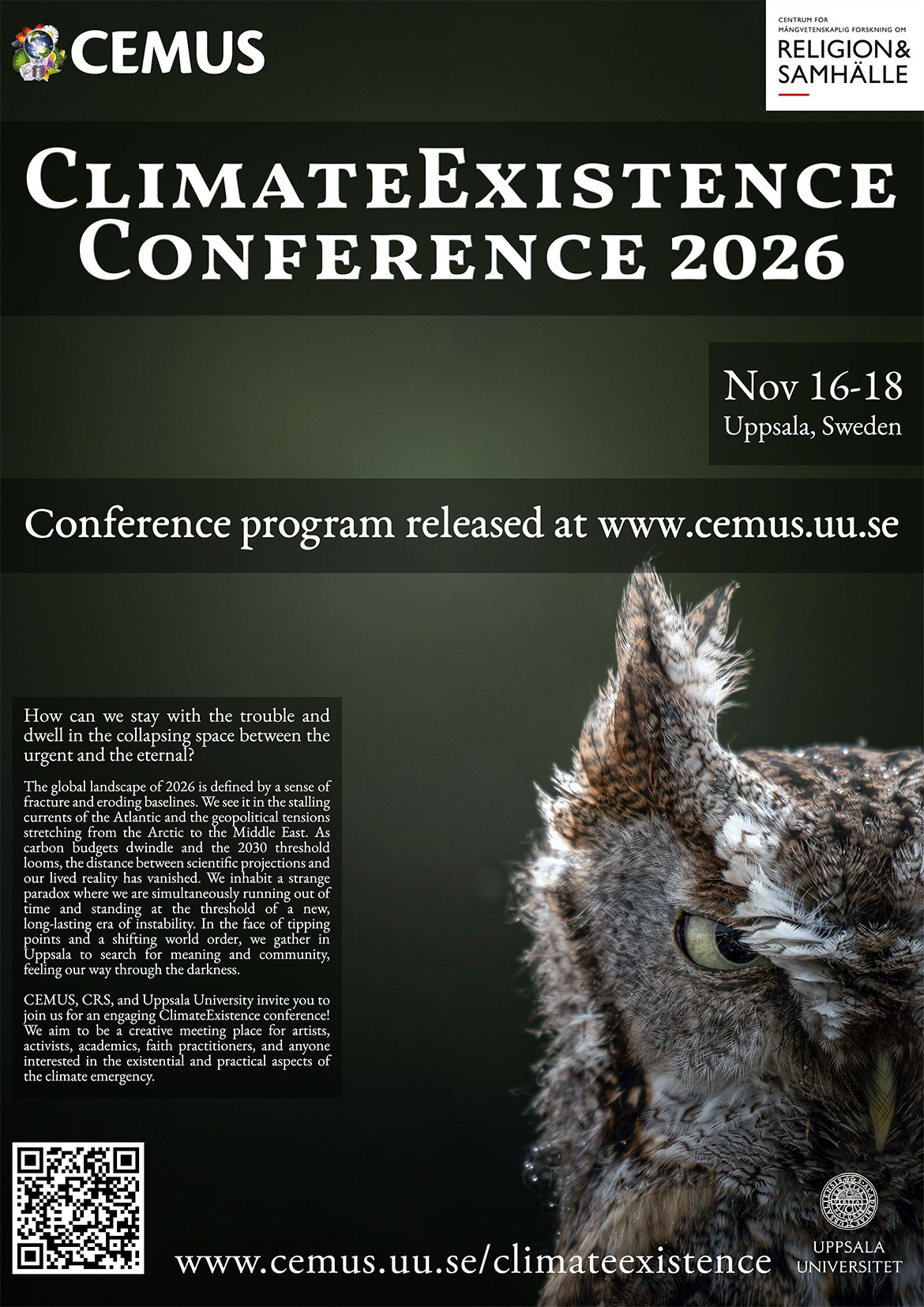
How can we stay with the trouble and dwell in the collapsing space between the urgent and the eternal?

The global landscape of 2026 is defined by a sense of fracture and eroding baselines. We see it in the stalling currents of the Atlantic and the geopolitical tensions stretching from the Arctic to the Middle East. As carbon budgets dwindle and the 2030 threshold looms, the distance between scientific projections and our lived reality has vanished. We inhabit a strange paradox where we are simultaneously running out of time and standing at the threshold of a new, long-lasting era of instability. In the face of tipping points and a shifting world order, we gather in Uppsala to search for meaning and community, feeling our way through the darkness.

How do we maintain a sense of place and direction when the natural and political maps are being redrawn and discarded? In an age of extreme weather and ecological loss, how do we navigate the tension between immediate crisis and the slow, deep time of the earth? If the systems we relied upon are failing, what new bridges can we build between the practical needs of survival and the existential need for meaning? How can we stay with the trouble and dwell in the collapsing space between the urgent and the eternal?

CEMUS, CRS, and Uppsala University invite you to join us for an engaging ClimateExistence conference! We aim to be a creative meeting place for artists, activists, academics, faith practitioners, and anyone interested in the existential and practical aspects of the climate emergency.